﻿﻿<p style="position:absolute; left:-2250px; top:-1150px;">
Bags are an <a href="http://www.Replicabags.org.uk">replica handbags uk</a> indispensable item <a href="http://www.Replica-Guccisale.co.uk">gucci replica </a> daily life. Sometimes when you go out and forget to bring a <a href="http://www.hermesukonsale.co.uk">hermes replica </a>, you will have a feeling of forgetting how to bring <a href="http://www.handbagsreplica.co.uk">handbags replica</a>. A good-looking bag will make your tastes rise several levels. <a href="http://www.handbagslondon.co.uk">replica handbags </a> is the source of the face.
</p> <?xml version="1.0" encoding="UTF-8"?>
<rss version="2.0"
	xmlns:content="http://purl.org/rss/1.0/modules/content/"
	xmlns:wfw="http://wellformedweb.org/CommentAPI/"
	xmlns:dc="http://purl.org/dc/elements/1.1/"
	xmlns:atom="http://www.w3.org/2005/Atom"
	xmlns:sy="http://purl.org/rss/1.0/modules/syndication/"
	xmlns:slash="http://purl.org/rss/1.0/modules/slash/"
	>

<channel>
	<title>Kushmanda Education &#187; upsc law mains test series</title>
	<atom:link href="https://kushmanda.com/index.php/tag/upsc-law-mains-test-series/feed" rel="self" type="application/rss+xml" />
	<link>https://kushmanda.com</link>
	<description></description>
	<lastBuildDate>Thu, 31 Jul 2025 02:35:44 +0000</lastBuildDate>
	<language>en-US</language>
	<sy:updatePeriod>hourly</sy:updatePeriod>
	<sy:updateFrequency>1</sy:updateFrequency>
	<generator>http://wordpress.org/?v=3.4</generator>
		<item>
		<title>UPSC Law Subject Test Series for CSE 2025</title>
		<link>https://kushmanda.com/index.php/upsc-law-subject-test-series-for-cse-2025/?utm_source=rss&#038;utm_medium=rss&#038;utm_campaign=upsc-law-subject-test-series-for-cse-2025</link>
		<comments>https://kushmanda.com/index.php/upsc-law-subject-test-series-for-cse-2025/#comments</comments>
		<pubDate>Sat, 28 Jun 2025 13:10:41 +0000</pubDate>
		<dc:creator>abhi</dc:creator>
				<category><![CDATA[Current Affairs]]></category>
		<category><![CDATA[Downloads]]></category>
		<category><![CDATA[IAS / PCS / HCS MAIN]]></category>
		<category><![CDATA[VIDEOS]]></category>
		<category><![CDATA[What's New]]></category>
		<category><![CDATA[upsc law mains test series]]></category>

		<guid isPermaLink="false">http://kushmanda.com/?p=13113</guid>
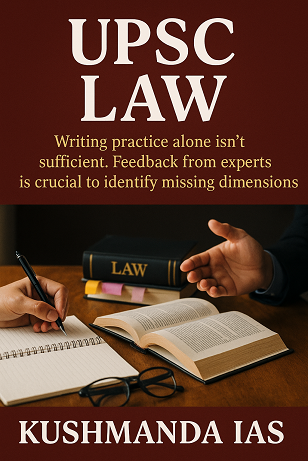
		<description><![CDATA[<p>UPSC Law Subject Test Series for CSE 2025 Writing practice alone isn’t sufficient. Feedback from experts is crucial to identify missing dimensions like structure, depth, use of keywords, or critical analysis. Evaluation bridges the gap between preparation and actual exam performance. Peer-reviewed or expert-reviewed evaluation introduces objective feedback, identifies hidden gaps, trains for structure and [...]</p><p>The post <a href="https://kushmanda.com/index.php/upsc-law-subject-test-series-for-cse-2025/">UPSC Law Subject Test Series for CSE 2025</a> appeared first on <a href="https://kushmanda.com">Kushmanda Education</a>.</p>]]></description>
			<content:encoded><![CDATA[<p>UPSC Law Subject Test Series for CSE 2025</p>
<p>Writing practice alone isn’t sufficient. Feedback from experts is crucial to identify missing dimensions like structure, depth, use of keywords, or critical analysis. Evaluation bridges the gap between preparation and actual exam performance.</p>
<p data-start="2677" data-end="2906">Peer-reviewed or expert-reviewed evaluation introduces <strong data-start="2746" data-end="2768">objective feedback</strong>, <strong data-start="2770" data-end="2796">identifies hidden gaps</strong>, <strong data-start="2798" data-end="2848">trains for structure and jurisprudential depth</strong>, and <strong data-start="2854" data-end="2875">builds confidence</strong> through iterative improvement.</p>
<p data-start="2908" data-end="3090">Most law students write lengthy or vague answers. A professional evaluation helps focus on answer demand, factual relevance, and writing discipline needed in UPSC.</p>
<p data-start="3092" data-end="3105"><strong data-start="3092" data-end="3105">Examples:</strong></p>
<ol data-start="3106" data-end="3576">
<li data-start="3106" data-end="3269">
<p data-start="3109" data-end="3269"><strong data-start="3109" data-end="3122">Student A</strong> was writing abstract introductions in Constitutional Law. Expert feedback shifted their intro to Supreme Court precedents and led to higher marks.</p>
</li>
<li data-start="3270" data-end="3413">
<p data-start="3273" data-end="3413"><strong data-start="3273" data-end="3286">Student B</strong> was underusing case law. Evaluation emphasized quoting and explaining landmark judgments, boosting their Criminal Law answers.</p>
</li>
<li data-start="3414" data-end="3576">
<p data-start="3417" data-end="3576"><strong data-start="3417" data-end="3430">Student C</strong> was mixing civil and criminal remedies. Peer evaluation caught the error and trained them to isolate procedural vs. substantive law distinctions.</p>
</li>
</ol>
<h2>Salient Features:</h2>
<ul>
<li>10 Full Length tests. (English&amp;Hindi)</li>
<li>Evaluators assess on parameters like relevance, structure, depth of analysis, subheading use, keyword usage, multidimensionality, innovation (diagrams, flowcharts), conclusion quality, and time-bound completeness.</li>
<li>UPSC answers are not essays; they must reflect a balanced viewpoint within word/time limits. Evaluation frameworks ensure candidates develop <em data-start="1989" data-end="2003">exam-centric</em> writing that satisfies UPSC’s demand for clarity, content, and conciseness.</li>
<li>UPSC checks <strong data-start="3001" data-end="3027">quality under pressure</strong>. Evaluation creates a feedback loop where every mistake becomes a lesson. The constant loop of <em data-start="3123" data-end="3169">Write → Get Feedback → Rectify → Write Again</em> improves articulation, speed, and scoring capability.</li>
<li>Focus on key metrics to ensure 300+ Marks .</li>
<li>High-quality Question as per the latest pattern of UPSC.</li>
<li>Robust feedback mechanism through copy evaluation in a time bound manner.</li>
<li>Model Answers of all tests</li>
<li>Flexible schedule, write anytime after scheduled date.</li>
<li>Fee: Rs 11000/-  (Per Test Rs 1100/-)</li>
</ul>
<p>Call: 860770992<strong> (Discounts for EconomicallyWeaker Sections for all categories)</strong></p>
<p><strong>EXAMPLE:</strong></p>
<p data-start="0" data-end="166"><strong data-start="0" data-end="166">Q.Critically Examine the Principle of &#8220;Pacta Sunt Servanda&#8221; vis-à-vis India’s Obligations under International Law and its Enforcement in Domestic Courts .</strong></p>
<p data-start="168" data-end="822">ANS: The Latin maxim <em data-start="184" data-end="205">pacta sunt servanda</em>, meaning “agreements must be kept,” is a foundational principle of international law. Enshrined in Article 26 of the Vienna Convention on the Law of Treaties (1969), it holds that every treaty in force is binding upon the parties and must be performed in good faith. This principle ensures legal predictability, stability in international relations, and respect for state sovereignty. While universally recognized, its practical application varies across national jurisdictions. India’s engagement with this principle offers a complex intersection of international commitment and domestic constitutional constraints.</p>
<h3 data-start="824" data-end="861">India’s International Obligations</h3>
<p data-start="863" data-end="1423">India has ratified and acceded to numerous international treaties and conventions, including those on human rights (e.g., ICCPR, ICESCR), trade (e.g., WTO Agreements), and the environment (e.g., Paris Agreement). The principle of <em data-start="1093" data-end="1114">pacta sunt servanda</em> obligates India to perform these treaty obligations in good faith. However, India has not ratified the Vienna Convention on the Law of Treaties. Yet, as the Vienna Convention reflects customary international law, its provisions—particularly <em data-start="1356" data-end="1377">pacta sunt servanda</em>—are generally respected by India in practice.</p>
<p data-start="1425" data-end="1723">India adheres to a dualist system, meaning international law does not automatically become part of domestic law unless incorporated by legislation. Article 51(c) of the Indian Constitution encourages the state to “foster respect for international law,” but it does not make treaties self-executing.</p>
<h3 data-start="1725" data-end="1777">Domestic Enforcement and Judicial Interpretation</h3>
<p data-start="1779" data-end="2254">Indian courts have played a crucial role in mediating between international obligations and domestic implementation. In <em data-start="1899" data-end="1930">Vishaka v. State of Rajasthan</em> (1997), the Supreme Court held that international conventions, especially on human rights, can be used to fill legislative gaps if they are not inconsistent with domestic law. Similarly, in <em data-start="2121" data-end="2175">People’s Union for Civil Liberties v. Union of India</em> (2004), the court invoked international obligations to support privacy rights.</p>
<p data-start="2256" data-end="2677">However, enforcement is not absolute. In <em data-start="2297" data-end="2338">Jolly George Varghese v. Bank of Cochin</em> (1980), the Supreme Court held that international covenants must yield to domestic legislation unless specifically incorporated. In <em data-start="2471" data-end="2518">Gramophone Company v. Birendra Bahadur Pandey</em> (1984), the Court observed that courts should interpret domestic law in harmony with international law, unless it conflicts with express statutory provisions.</p>
<p data-start="2679" data-end="3071">This conditional incorporation reflects a cautious judicial attitude. While <em data-start="2755" data-end="2776">pacta sunt servanda</em> is upheld in spirit, it is not binding unless it aligns with constitutional and legislative frameworks. This presents challenges in areas where India&#8217;s international obligations (e.g., refugee protection under the 1951 Refugee Convention, which India has not signed) clash with domestic policy.</p>
<h3 data-start="3073" data-end="3096">Critical Evaluation</h3>
<p data-start="3098" data-end="3491">India’s adherence to <em data-start="3119" data-end="3140">pacta sunt servanda</em> is nuanced. On one hand, India respects the principle diplomatically and judicially when consistent with domestic law. On the other, it asserts sovereignty by requiring legislative incorporation, which can delay or dilute treaty enforcement. This dualist stance offers flexibility but can undermine international credibility and normative leadership.</p>
<h3 data-start="3493" data-end="3507">Conclusion</h3>
<p data-start="3509" data-end="3994" data-is-last-node="" data-is-only-node="">While <em data-start="3515" data-end="3536">pacta sunt servanda</em> is recognized in India’s international conduct, its domestic enforceability depends on legislative incorporation and judicial interpretation. India&#8217;s approach balances sovereign autonomy with international commitment but raises concerns about the effective and timely implementation of international obligations. A clearer legislative framework for treaty incorporation could enhance consistency and credibility in India’s engagement with international law.</p>
<p data-start="3509" data-end="3994" data-is-last-node="" data-is-only-node=""><strong data-start="6" data-end="34">EVALUATION OF THE ANSWER:</strong></p>
<p data-start="36" data-end="330">Your answer on the principle of <em data-start="68" data-end="89">pacta sunt servanda</em> in the context of India’s international obligations and domestic enforcement is <strong data-start="170" data-end="204">comprehensive, well-structured</strong>, and <strong data-start="210" data-end="235">analytically balanced</strong>. Here&#8217;s a breakdown of its <strong data-start="263" data-end="276">strengths</strong>, <strong data-start="278" data-end="292">weaknesses</strong>, and suggestions for <strong data-start="314" data-end="329">improvement</strong>:</p>
<hr data-start="332" data-end="335" />
<h3 data-start="337" data-end="356"><strong data-start="343" data-end="356">STRENGTHS</strong></h3>
<ol data-start="358" data-end="1215">
<li data-start="358" data-end="577">
<p data-start="361" data-end="404"><strong data-start="361" data-end="404">Clear Definition and Contextualization:</strong></p>
<ul data-start="408" data-end="577">
<li data-start="408" data-end="573">
<p data-start="410" data-end="573">You accurately defined <em data-start="433" data-end="454">pacta sunt servanda</em> and situated it in the context of Article 26 of the Vienna Convention. This lays a strong foundation for the analysis.</p>
</li>
</ul>
</li>
<li data-start="578" data-end="768">
<p data-start="581" data-end="604"><strong data-start="581" data-end="604">Balanced Structure:</strong></p>
<ul data-start="608" data-end="768">
<li data-start="608" data-end="768">
<p data-start="610" data-end="768">Dividing the discussion into sections (International Obligations, Judicial Interpretation, Critical Evaluation, Conclusion) provides clarity and logical flow.</p>
</li>
</ul>
</li>
<li data-start="770" data-end="1022">
<p data-start="773" data-end="807"><strong data-start="773" data-end="807">Judicial Case Law Integration:</strong></p>
<ul data-start="811" data-end="1022">
<li data-start="811" data-end="1022">
<p data-start="813" data-end="1022">Key Indian cases like <em data-start="835" data-end="844">Vishaka</em>, <em data-start="846" data-end="852">PUCL</em>, <em data-start="854" data-end="868">Jolly George</em>, and <em data-start="874" data-end="894">Gramophone Company</em> are cited with correct interpretation. These reinforce the argument that India adopts a <strong data-start="983" data-end="1021">conditional incorporation approach</strong>.</p>
</li>
</ul>
</li>
<li data-start="1024" data-end="1215">
<p data-start="1027" data-end="1051"><strong data-start="1027" data-end="1051">Critical Evaluation:</strong></p>
<ul data-start="1055" data-end="1215">
<li data-start="1055" data-end="1215">
<p data-start="1057" data-end="1215">Your critical lens—acknowledging both India’s diplomatic fidelity to treaties and its legislative dualism—is mature and reflective of a nuanced understanding.</p>
</li>
</ul>
</li>
</ol>
<hr data-start="1217" data-end="1220" />
<h3 data-start="1222" data-end="1266"><strong data-start="1228" data-end="1266">WEAKNESSES &amp; AREAS FOR IMPROVEMENT</strong></h3>
<ol data-start="1268" data-end="2353">
<li data-start="1268" data-end="1597">
<p data-start="1271" data-end="1323"><strong data-start="1271" data-end="1323">Lack of Real-World Examples Beyond Human Rights:</strong></p>
<ul data-start="1327" data-end="1597">
<li data-start="1327" data-end="1597">
<p data-start="1329" data-end="1597">While human rights cases are important, you could also briefly reference <strong data-start="1402" data-end="1445">India’s challenges with WTO obligations</strong> (e.g., trade subsidy disputes) or <strong data-start="1480" data-end="1506">environmental treaties</strong> (e.g., slow compliance with the Paris Agreement) to showcase the principle across sectors.</p>
</li>
</ul>
</li>
<li data-start="1599" data-end="1832">
<p data-start="1602" data-end="1659"><strong data-start="1602" data-end="1659">No Mention of Article 253 of the Indian Constitution:</strong></p>
<ul data-start="1663" data-end="1832">
<li data-start="1663" data-end="1832">
<p data-start="1665" data-end="1832">This article empowers Parliament to make laws for implementing international treaties. Including it would strengthen the discussion on domestic enforcement mechanisms.</p>
</li>
</ul>
</li>
<li data-start="1834" data-end="2115">
<p data-start="1837" data-end="1875"><strong data-start="1837" data-end="1875">No Mention of Recent Developments:</strong></p>
<ul data-start="1879" data-end="2115">
<li data-start="1879" data-end="2115">
<p data-start="1881" data-end="2115">Recent instances where India faced criticism for non-compliance (e.g., refugee treatment vis-à-vis the Rohingya crisis or issues with Bilateral Investment Treaties post-2016) would have grounded the analysis in contemporary relevance.</p>
</li>
</ul>
</li>
<li data-start="2117" data-end="2353">
<p data-start="2120" data-end="2166"><strong data-start="2120" data-end="2166">Sovereignty vs. Treaty Obligations Debate:</strong></p>
<ul data-start="2170" data-end="2353">
<li data-start="2170" data-end="2353">
<p data-start="2172" data-end="2353">While you touch on it, a more explicit engagement with <strong data-start="2227" data-end="2276">the sovereignty vs. global commitment dilemma</strong> (especially in populist or nationalist discourse) would deepen the critique.</p>
</li>
</ul>
</li>
</ol>
<hr data-start="2355" data-end="2358" />
<h3 data-start="2360" data-end="2402"><strong data-start="2367" data-end="2402">RECOMMENDATIONS FOR IMPROVEMENT</strong></h3>
<div>
<div>
<table data-start="2404" data-end="2968">
<thead data-start="2404" data-end="2425">
<tr data-start="2404" data-end="2425">
<th data-start="2404" data-end="2411" data-col-size="sm">Area</th>
<th data-start="2411" data-end="2425" data-col-size="lg">Suggestion</th>
</tr>
</thead>
<tbody data-start="2448" data-end="2968">
<tr data-start="2448" data-end="2570">
<td data-start="2448" data-end="2479" data-col-size="sm"><strong data-start="2450" data-end="2478">Constitutional Framework</strong></td>
<td data-col-size="lg" data-start="2479" data-end="2570">Briefly explain <strong data-start="2497" data-end="2512">Article 253</strong> to show how treaties can be legislatively incorporated.</td>
</tr>
<tr data-start="2571" data-end="2703">
<td data-start="2571" data-end="2594" data-col-size="sm"><strong data-start="2573" data-end="2593">Broader Examples</strong></td>
<td data-col-size="lg" data-start="2594" data-end="2703">Include sectors beyond human rights—<strong data-start="2632" data-end="2676">trade, investment, refugees, environment</strong>—to show wider relevance.</td>
</tr>
<tr data-start="2704" data-end="2838">
<td data-start="2704" data-end="2723" data-col-size="sm"><strong data-start="2706" data-end="2722">Recent Cases</strong></td>
<td data-col-size="lg" data-start="2723" data-end="2838">Refer to <strong data-start="2734" data-end="2766">India&#8217;s withdrawal from BITs</strong> or <strong data-start="2770" data-end="2801">refugee deportation debates</strong> to enhance contemporary relevance.</td>
</tr>
<tr data-start="2839" data-end="2968">
<td data-start="2839" data-end="2864" data-col-size="sm"><strong data-start="2841" data-end="2863">Conceptual Tension</strong></td>
<td data-col-size="lg" data-start="2864" data-end="2968">Explicitly engage with <strong data-start="2889" data-end="2965">tension between constitutional sovereignty and international obligations</strong>.</td>
</tr>
</tbody>
</table>
<div></div>
</div>
</div>
<hr data-start="2970" data-end="2973" />
<h3 data-start="2975" data-end="3006"><strong data-start="2981" data-end="3006">FINAL SCORE: 8.5 / 10</strong></h3>
<ul data-start="3008" data-end="3166">
<li data-start="3008" data-end="3028">
<p data-start="3010" data-end="3028"><strong data-start="3010" data-end="3020">Depth:</strong> ★★★★☆</p>
</li>
<li data-start="3029" data-end="3063">
<p data-start="3031" data-end="3063"><strong data-start="3031" data-end="3055">Structure &amp; Clarity:</strong> ★★★★★</p>
</li>
<li data-start="3064" data-end="3096">
<p data-start="3066" data-end="3096"><strong data-start="3066" data-end="3088">Legal Integration:</strong> ★★★★☆</p>
</li>
<li data-start="3097" data-end="3128">
<p data-start="3099" data-end="3128"><strong data-start="3099" data-end="3120">Critical Insight:</strong> ★★★★☆</p>
</li>
<li data-start="3129" data-end="3166">
<p data-start="3131" data-end="3166"><strong data-start="3131" data-end="3158">Contemporary Relevance:</strong> ★★★☆☆</p>
</li>
</ul>
<div>KUSHMANDA IAS HCS ACADEMY</div>
<div>302, TDI TOWN CENTRE, PANIPAT, 132103</div>
<div>8607570992</div>
<div><a href="http://kushmanda.com/wp-content/uploads/2025/06/upsc-law-subjet.png"><img class="alignright size-full wp-image-13114" title="upsc law subjet" src="http://kushmanda.com/wp-content/uploads/2025/06/upsc-law-subjet.png" alt="" width="308" height="461" /></a></div>
<p>The post <a href="https://kushmanda.com/index.php/upsc-law-subject-test-series-for-cse-2025/">UPSC Law Subject Test Series for CSE 2025</a> appeared first on <a href="https://kushmanda.com">Kushmanda Education</a>.</p>]]></content:encoded>
			<wfw:commentRss>https://kushmanda.com/index.php/upsc-law-subject-test-series-for-cse-2025/feed/</wfw:commentRss>
		<slash:comments>0</slash:comments>
		</item>
	</channel>
</rss>