The post Anthropology UPSC Study Material appeared first on Kushmanda Education.
]]>
“Exams are fast approaching. Work Smart:You have limited time and energy.”
Anthropology
What you will get:
- Complete Study Material
- Scoring potential test papers ( expected questions)
- Answers of every test paper (Most Realistic Practice )
- Expert Support (through email kushmandaeducation@gmail.com)
- English/Hindi
FEE : Rs 16000/-
“Making good decisions is a crucial skill at every level. You should not waste this opportunity for just a sake of only appearing the examination. Give this attempt with the full fire. So join us immediately.”
PAPER‐I
1.1 Meaning, Scope and development of Anthropology.
1.2 Relationships with other disciplines : Social Sciences, behavioural Sciences, Life Sciences, Medical Sciences, Earth Sciences and Humanities.
1.3 Main branches of Anthropology, their scope and relevance : (a) Social-cultural Anthropology.
(b) Biological Anthropology.
(c) Archaeological Anthropology. (d) Linguistic Anthropology.
1.4 Human Evolution and emergence of Man :
(a) Biological and Cultural factors in human evolution.
(b) Theories of Organic Evolution (Pre-Darwinian, Darwinian and Post-Darwinian).
(c) Synthetic theory of evolution; Brief outline of terms and concepts of evolutionary biology (Doll’s rule, Cope’s rule, Gause’s rule, parallelism, convergence, adaptive radiation, and mosaic evolution).
1.5 Characteristics of Primates; Evolutionary Trend and Primate Taxonomy; Primate Adaptations; (Arboreal and Terrestrial) Primate Taxonomy; Primate Behaviour; Tertiary and Quaternary fossil primates; Living Major Primates; Comparative Anatomy of Man and Apes; Skeletal changes due to erect posture and its implications.
1.6 Phylogenetic status, characteristics and geographical distribution of the following : (a) Plio-preleistocene hominids inSouth and East Africa—Australopithecines.
(b) Homo erectus : Africa (Paranthropus), Europe (Homo erectus (heidelbergensis), Asia
(Homo erectus javanicus, Homo erectus pekinensis.
(c) Neanderthal man—La-chapelle-aux-saints (Classical type), Mt. Carmel (Progressive type).
(d) Rhodesian man.
(e) Homo saoiens—Cromagnon, Grimaldi and Chancelede.
1.7 The biological basis of Life : The Cell, DNA structure and replication, Protein Synthesis, Gene, Mutation, Chromosomes, and Cell Division.
1.8 (a) Principles of Prehistoric Archaeology. Chronology : Relative and Absolute Dating
methods.
(b) Cultural Evolution—Broad Outlines of Prehistoric cultures : (i) Paleolithic
(ii) Mesolithic (iii) Neolithic (iv) Chalcolithic
(v) Copper-Bronze Age
(vi) Iron Age
2.1 The Nature of Culture : The concept and Characteristics of culture and civilization; Ethnocentrism vis-a-vis cultural Relativism.
2.2 The Nature of Society : Concept of Society; Society and Culture; Social Institution; Social groups; and Social stratification.
2.3 Marriage : Definition and universality; Laws of marriage (endogamy, exogamy, hypergamy, hypogamy, incest taboo); Type of marriage (monogamy, polygamy, polyandry, group marriage). Functions of marriage; Marriage regulations (preferential, prescriptive and proscriptive); Marriage payments (bride wealth and dowry).
2.4 Family : Definition and universality; Family, household and domestic groups; functions of family; Types of family (from the perspectives of structure, blood relation, marriage, residence and succession); Impact of urbanization, industrialization and feminist movements on family.
2.5 Kinship : Consanguinity and Affinity; Principles and types of descent (Unilineal, Double, Bilateral Ambilineal); Forms of descent groups (lineage, clan, phratry, moiety and kindred); Kinship terminology (descriptive and classificatory); Descent, Filiation and Complimentary Filiation;Decent and Alliance.
3. Economic Organization : Meaning, scope and relevance of economic anthropology; Formalist and Substantivist debate; Principles governing production, distribution and exchange (reciprocity, redistribution and market), in communities, subsisting on hunting and gathering, fishing, swiddening, pastoralism, horticulture, and agriculture; globalization and indigenous economic systems.
4. Political Organization and Social Control : Band, tribe, chiefdom, kingdom and state; concepts of power, authority and legitimacy; social control, law and justice in simple Societies.
5. Religion : Anthropological approaches to the study of religion (evolutionary, psychological and functional); monotheism and polytheism; sacred and profane; myths and rituals; forms of religion in tribal and peasant Societies (animism, animatism, fetishism, naturism and totemism); religion, magic and science distinguished; magico-religious functionaries (priest, shaman, medicine man, sorcerer and witch).
6. Anthropological theories :
(a) Classical evolutionism (Tylor, Morgan and Frazer)
(b) Historical particularism (Boas) Diffusionism (British, German and American) (c) Functionalism (Malinowski); Structural—Functionlism (Radcliffe-Brown)
(d) Structuralism (L’evi-Strauss and E. Leach)
(e) Culture and personality (Benedict, Mead, Linton, Kardiner and Cora-du Bois) (f) Neo—evolutionism (Childe, White, Steward, Sahlins and Service)
(g) Cultural materialism (Harris)
(h) Symbolic and interpretive theories (Turner, Schneider and Geertz) (i) Cognitive theories (Tyler, Conklin)
(j) Post-modernism in anthropology.
7. Culture, Language and Communication :
Nature, origin and characteristics of language; verbal and non-verbal communication; social contex of language use.
8. Research methods in Anthropology :
(a) Fieldwork tradition in anthropology
(b) Distinction between technique, method and methodology
(c) Tools of data collection : observation, interview, schedules, questionnaire, case study, genealogy, life-history, oral history, secondary sources of information, participatory methods.
(d) Analysis, interpretation and presentation of data.
9.1 Human Genetics : Methods and Application : Methods for study of genetic principles in man-family study (pedigree analysis, twin study, foster child, co-twin method, cytogenetic method, chromosomal and karyo-type analysis), biochemical methods, immunological methods, D.N.A. technology and recombinant technologies.
9.2 Mendelian genetics in man-family study, single factor, multifactor, lethal, sub-lethal and polygenic inheritance in man.
9.3 Concept of genetic polymorphism and selection, Mendelian population, Hardy-Weinberg law; causes and changes which bring down frequency-mutation, isolation, migration, selection, inbreeding and genetic drift. Consanguineous and non-consanguineous mating, genetic load, genetic effect of consanguineous and cousin marriages.
9.4 Chromosomes and chromosomal aberrations in man, methodology. (a) Numerical and structural aberrations (disorders).
(b) Sex chromosomal aberration- Klinefelter (XXY), Turner (XO), Super female (XXX), intersex and other syndromic disorders.
(c)Autosomal aberrations- Down syndrome, Patau, Edward and Cri-du-chat syndromes.
(d) Genetic imprints in human disease, genetic screening, genetic counseling, human DNA
profiling, gene mapping and genome study.
9.5 Race and racism, biological basis of morphological variation of non-metric and characters.
Racial criteria, racial traits in relation to heredity and environment; biological basis of racial
classification, racial differentiation and race crossing in man.
9.6 Age, sex and population variation as genetic marker :ABO, Rh blood groups, HLA Hp, transferring, Gm, blood enzymes. Physiological characteristics-Hb level, body fat, pulse rate, respiratory functions and sensory perceptions in different cultural and socio-ecomomic groups.
9.7 Concepts and methods of Ecological Anthropology : Bio-cultural Adaptations—Genetic and Non-genetic factors. Man’s physiological responses to environmental stresses: hot desert, cold, high altitude climate.
9.8 Epidemiological Anthropology : Health and disease. Infectious and non-infectious diseases, Nutritional deficiency related diseases.
10. Concept of human growth and Development : Stages of growth—pre-natal, natal, infant, childhood, adolescence, maturity, senescence.
—Factors affecting growth and development genetic, environmental, biochemical, nutritional, cultural and socio-economic.
—Ageing and senescence. Theories and observations
—Biological and chronological longevity. Human physique and somatotypes. Methodologies for growth studies.
11.1 Relevance of menarche, menopause and other bioevents to fertility. Fertility patterns and differentials.
11.2 Demographic theories-biological, social and cultural.
11.3 Biological and socio-ecological factors influencing fecundity, fertility, natality and mortality.
12. Applications of Anthropology : Anthropology of sports, Nutritional anthropology, Anthroplogy in designing of defence and other equipments, Forensic Anthroplogy, Methods and principles of personal identification and reconstruction, Applied human genetics—Paternity diagnosis, genetic counselling and eugenics, DNA technology in
diseases and medicine, serogenetics and cytogenetics in reproductive biology.
PAPER‐II
1.1 Evolution of the Indian Culture and Civilization—Prehistoric (Palaeolithic, Mesolithic, Neolithic and Neolithic-Chalcolithic), Protohistoric (Indus Civilization). Pre-Harappan, Harappan and post-Harappan cultures. Contributions of the tribal cultures to Indian civilization.
1.2 Palaeo—Anthropological evidences from India with special reference to Siwaliks and
Narmada basin (Ramapithecus, Sivapithecus and Narmada Man).
1.3. Ethno‐archaeology in India: The concept of ethno-archaeology; Survivals and Parallels among the hunting, foraging, fishing, pastoral and peasant communities including arts and crafts producing communities.
2. Demographic profile of India—Ethnic and linguistic elements in the Indian population and their distribution. Indian population—factors influencing its structure and growth.
3.1 The structure and nature of traditional Indian social system—Varnashram, Purushartha, Karma, Rina and Rebirth.
3.2 Caste system in India— Structure and characteristics Varna and caste, Theories of origin of caste system, Dominant caste, Caste mobility, Future of caste system, Jajmani system. Tribe-case continuum.
3.3 Sacred Complex and Nature-Man-Spirit Complex.
3.4. Impact of Buddhism, Jainism, Islam and Christianity of Indian society.
4. Emergence, growth and development in India—Contributions of the 18th, 19th and early
20th Century scholar-administrators. Contributions of Indian anthropologists to tribal and caste studies.
5.1 Indian Village—Significane of village study in India; Indian village as a social system; Traditional and changing patterns of settlement and inter-caste relations; Agrarian relations in Indian villages; Impact of globalization on Indian villages.
5.2 Linguistic and religious minorities and their social, political and economic status.
5.3 Indigenous and exogenous processes of socio-cultural change in Indian society: Sanskritization, Westernization, Modernization; Inter-play of little and great traditions; Panchayati Raj and social change; Media and Social change.
6.1 Tribal situation in India—Bio-genetic variability, linguistic and socio-economic characteristics of the tribal populations and their distribution.
6.2 Problems of the tribal Communities—Land alienation, poverty, indebtedness, low literacy, poor educational facilities, unemployment, under- employment, health and nutrition.
6.3 Developmental projects and their impact on tribal displacement and problems of rehabilitation. Development of forest policy and tribals. Impact of urbanisation and industrialization on tribal populations.
7.1 Problems of exploitation and deprivation of Scheduled Castes, Scheduled Tribes and Other
Backward Classes. Constitutional safeguards for Scheduled Tribes and Scheduled Castes.
7.2 Social change and contemporary tribal societies : Impact of modern democratic institutions, development programmes and welfare measures on tribals and weaker sections.
7.3 The concept of ethnicity; Ethnic conflicts and political developments; Unrest among tribal communities; Regionalism and demand for autonomy; Pseudo-tribalism. Social change among the tribes during colonial and post-Independent India.
8.1 Impact of Hinduism, Buddhism, Christianity, Islam and other religions on tribal societies.
8.2 Tribe and nation state—a comparative study of tribal communities in India and other countries.
9.1 History of administration of tribal areas, tribal policies, plans, programmes of tribal development and their implementation. The concept of PTGs (Primitive Tribal Groups), their distribution, special programmes for their development. Role of N.G.O.s in tribal development.
9.2 Role of anthropology in tribal and rural development.
9.3 Contributions of anthropology to the understanding of regionalism, communalism and
ethnic and political movements.
The post Anthropology UPSC Study Material appeared first on Kushmanda Education.
]]>The post Animal Husbandry UPSC Study Material appeared first on Kushmanda Education.
]]>
“Exams are fast approaching. Work Smart:You have limited time and energy.”
Animal Husbandry and Veterinary Science
What you will get:
- Complete Study Material
- Scoring potential test papers ( expected questions)
- Answers of every test paper (Most Realistic Practice )
- Expert Support (through email kushmandaeducation@gmail.com)
- English/Hindi
FEE : Rs 16000/-
“Making good decisions is a crucial skill at every level. You should not waste this opportunity for just a sake of only appearing the examination. Give this attempt with the full fire. So join us immediately.”
ANIMAL HUSBANDRY AND VETERINARY SCIENCE
PAPER‐I
1. Animal Nutrition :
1.1 Partitioning of food energy within the animal. Direct and indirect calorimetry.
Carbon—nitrogen balance and comparative slaughter methods. Systems for expressing energy value of foods in ruminants, pigs and poultry. Energy requirements for maintenance, growth, pregnancy, lactation, egg, wool, and meat production.
1.2 Latest advances in protein nutrition. Energy protein inter-relationships. Evaluation of protein quality. Use of NPN compounds in ruminant diets. Protein requirements for maintenance, growth, pregnancy, lactation, egg, wool and meat production.
1.3 Major and trace minerals—Their sources, physiological functions and deficiency symptoms.
Toxic minerals. Mineral interactions. Role of fatsoluble and water—soluble vitamins in the body, their sources and deficiency symptoms.
1.4 Feed additives—methane inhibitors, probiotics, enzymes, antibiotics, hormones, oligosaccharides, antioxidants, emulsifiers, mould inhibitors, buffers etc. Use and abuse of growth promoters like harmones and antibiotics—latest concepts.
1.5 Conservation of fodders. Storage of feeds and feed ingredients. Recent advances in feed technology and feed processing. Anti-nutritional and toxic factors present in livestock feeds. Feed analysis and quality control. Digestibility trials—direct, indirect and indicator methods. Predicting feed intake in grazing animals.
1.6 Advances in ruminant nutrition. Nutrient requirements. Balanced rations. Feeding of calves, pregnant, work animals and breeding bulls. Strategies for feeding milch animals during different stages of lactation cycle. Effect of feeding on milk composition. Feeding of goats for meat and milk production. Feeding of sheep for meat and wool production.
1.7 Swine Nutrition. Nutrient requirements. Creep, starter, grower and finisher rations. Feeding of pigs for lean meat production. Low cost rations for swine.
1.8 Poultry nutrition. Special features of poultry nutrition. Nutrient requirements for meat and egg production. Formulation of rations for different classes of layers and broilers.
2. Animal Physiology :
2.1 Physiology of blood and its circulation, respiration; excretion. Endocrine glands in health and disease.
2.2 Blood constituents.—Properties and functions-blood cell formation—Haemoglobin synthesis and chemistry-plasma proteins production, classification and properties, coagulation of blood; Haemorrhagic disorders—anti-coagulants—blood groups—Blood volume—Plasma expanders-Buffer systems in blood. Biochemical tests and their significance in disease diagnosis.
2.3 Circulation.—Physiology of heart, cardiac cycle, heart sounds, heart beat, electrocardiograms. Work and efficiency of heart—effect of ions on heart function-metabolism of cardiac muscle, nervous and chemical regulation of heart, effect of temperature and stress on heart, blood pressuer and hypertension, osmotic regulation, arterial pulse, vasomotor regulation of circulation, shock. Coronary and pulmonary
circulation, Blood-Brain barrier Cerebrospinal fluid-circulation in birds.
2.4 Respiration.—Mechanism of respiration, Transport and exchange of gases-neural control of respiration-Chemo-receptors-hypoxia-respiration in birds.
2.5 Excretion.—Structure and function of kidney-formation of urine-methods of studying renal function-renal regulation of acid-base balance : physiological constituents of urine-renal failure-passive venous congestion-Urinary secretion in chicken-Sweat glands and their function. Bio-chemical test for urinary dysfunction.
2.6 Endocrine glands.—Functional disorders—their symptoms and diagnosis. Synthesis of hormones, mechanism and control of secretion—hormonal receptors-classification and function.
2.7 Growth and Animal Production.—Prenatal and postnatal growth, maturation, growth curves, measures of growth, factors affecting growth, conformation, body composition, meat quality.
2.8 Physiology of Milk Production, Reproduction and Digestion.—Current status of hormonal control of mammary development, milk secretion and milk ejection. Male and Female reproductive organs, their components and functions. Digestive organs and their functions.
2.9 Environmental Physiology.—Physiological relations and their regulation; mechanisms of adaptation, environmental factors and regulatory mechanisms involved in animal behaviour, climatology—various parameters and their importance. Animal ecology. Physiology of behaviour. Effect of stress on health and production.
3. Animal Reproduction :
Semen quality.—Preservation and Artificial Insemination—Components of semen, composition of spermatozoa, chemical and physical properties of ejaculated semen, factors affecting semen in vivo and in vitro. Factors affecting semen production and quality, preservation, composition of diluents, sperm concentration, transport of diluted semen. Deep freezing techniques in cows, sheep, goats, swine and poultry. Detection of oestrus and time of insemination for better conception. Anoestrus and repeat breeding.
4. Livestock Production and Management :
4.1 Commercial Dairy Farming.—Comparison of dairy farming in India with advanced countries. Dairying under mixed farming and as specialized farming, economic dairy farming. Starting of a dairy farm, Capital and land requirement, organization of the dairy farm. Opportunities in dairy farming, factors determining the efficiency of dairy animal. Heard recording, budgeting cost of milk production, pricing policy; Personnel Management. Developing Practical and Economic rations for dairy cattle; supply of greens throughout the year, feed and fodder requirements of Dairy Farm. Feeding regimes for young stock and bulls, heifers and breeding animals; new trends in feeding young and adult stock; Feeding records.
4.2 Commercial meat, egg and wool production.—Development of practical and economic rations for sheep, goats, pigs, rabbits and poultry. Supply of greens, fodder, feeding regimes
for young and mature stock. New trends in enhancing production and management. Capital and land requirements and socio-economic concept.
4.3 Feeding and management of animals under drought, flood and other natural calamities.
5. Genetics and Animal Breeding :
5.1 History of animal genetics. Mitosis and Meiosis : Mendelian inheritance; deviations to Mendelian genetics; Expression of genes; Linkage and crossing over; Sex determination, sex influenced and sex limited characters; Blood groups and polymorphism; Chromosome aberrations; Cytoplasmic inheritance, Gene and its structure; DNA as a genetic material; Genetic code and protein synthesis; Recombinant DNA technology. Mutations, types of mutations, methods for detecting mutations and mutation rate, Transgenesis.
5.2 Population Genetics applied to Animal Breeding—Quantitative Vs. Qualitative traits; Hardy Weinberg Law; Population Vs. Individual; Gene and genotypic frequency; Forces changing gene frequency; Random drift and small populations; Theory of path coefficient; Inbreeding, methods of estimating inbreeding coefficient, systems of inbreeding; Effective population size; Breeding value, estimation of breeding value, dominance and epistatic deviation; Partitioning of variation; Genotype X environment correlation and genotype X environment interaction; role of multiple measurements; Resemblance between relatives.
5.3 Breeding Systems.—Breeds of livestsock and Poultry. Heritability, repeatability and genetic and phenotypic correlations, their methods of estimation and precision of estimates; Aids to selection and their relative merits; Individual, pedigree, family and within family selection; Pregnency testing; Methods of selection; Construction of selection indices and their uses; Comparative evaluation of genetic gains through various selection methods; Indirect selection and correlated response; Inbreeding, out breeding, upgrading, cross-breeding and synthesis of breeds; Crossing of inbred lines for commercial production; Selection for general and specific combining ability; Breeding for threshold characters. Sire index.
6. Extension :
Basic philosophy, objectives, concept and principles of extension. Different Methods adopted to educate farmers under rural conditions. Generation of technology, its transfer and feedback. Problems and constraints in transfer of technology. Animal husbandry
programmes for rural development.
1. Anatomy, Pharmacology and Hygiene :
PAPER‐II
1.1 Histology and Histological Techniques : Paraffin embedding technique of tissue processing and H.E. staining—Freezing microtomy—Microscopy Bright field microscope and electron microscope. Cytology-structure of cell organells and inclusions; cell division-cell types—Tissues and their classification-embryonic and adult tissues—Comparative histology of organs—Vascular, Nervous, digestive, respiratory, musculo-skeletal and urogenital systems—Endocrine glands—Integuments—sense organs.
1.2 Embryology.—Embryology of vertebrates with special reference to aves and domestic mammals gametogenesis-fertilization-germ layers-foetal membranes and placentation-types of placenta in domestic mammals-Teratology-twins and
twinning-organogenesis-germ layer derivatives-endodermal, mesodermal and ectodermal derivatives.
1.3 Bovine Anatomy.—Regional Anatomy : Paranasal sinuses of OX— surface anatomy of salivary glands. Regional anatomy of infraorbital, maxillary, mandi-buloalveolar, mental and cornnal nerve block. Regional anatomy of paravertebral nerves, pudental nerve, median, ulnar and radial nervestibial, fibular and digital nerves—Cranial nerves-structures involved in epidural anaesthesia-superficial lymph nodes-surface anatomy of visceral organs of thoracic, abdominal and pelvic cavities-comparative-features of locomotor apparatus and their application in the biomechanics of mammalian body.
1.4 Anatomy of Fowl.—Musculo-skeletal system-functional anatomy in relation to respiration and flying, digestion and egg production.
1.5 Pharmacology and therapeutics drugs.—Cellular level of pharmacodynamics and pharmacokinetics. Drugs acting on fluids and electrolyte balance. Drugs acting on Autonomic nervous system. Modern concepts of anaesthesia and dissociative anaesthetics. Autocoids. Antimicrobials and principles of chemotherapy in microbial infections. Use of hormones in therapeutics—chemotherapy of parasitic infections. Drug and economic concerns in the Edible tissues of animals—chemotherapy of Neoplastic diseases. Toxicity due to “insecticides, plants, metals, non-metals, zootoxins and mycotoxins”.
1.6 Veterinary Hygiene with reference to water, air and habitation.—Assessment of pollution of water, air and soil—Importance of climate in animal health—effect of environment on animal function and performance relationship between industrialisation and animal agriculture—animal housing requirements for specific categories of domestic animals viz. pregnant cows and sows, milking cows, broiler birds—stress, strain and productivity in relation to animal habitation.
2. Animal Diseases :
2.1 Etiology, epidemiology pathogenesis, symptoms, post-moretem lesions, diagnosis, and control of infectious diseases of cattle, sheep and goat, horses, pigs and poultry.
2.2 Etiology, epidemiology, symptoms, diagnosis, treatment of production diseases of cattle, horse, pig and poultry.
2.3 Deficiency diseases of domestic animals and birds.
2.4 Diagnosis and treatment of non-specific conditions like impaction, Bloat, Diarrhoea, Indigestion, dehydration, stroke, poisioning.
2.5 Diagnosis and treatment of neurological disorders.
2.6 Principles and methods of immunisation of animals against specific diseases—hard
immunity—disease free zones—‘zero’ disease concept—chemoprophylaxis.
2.7 Anaesthesia.—local, regional and general-prenesthetic medication. Symptoms and surgical interference in fractures and dislocation. Hernia, choking abomassal displacement—Caesarian operations. Rumenotomy—Castrations.
2.8 Disease investigation techniques.—Materials for laboratory investigation—Establishment. Animal Health Centres—Disease free zone.
3. Veterinary Public Health :
3.1 Zoonoses.—Classification, definition, role of animals and birds in prevalence and transmission of zoonotic diseases—occupational zoonotic diseases.
3.2 Epidemiology.—Principle, definition of epidemiological terms, application of epidemiological measures in the study of diseases and disease control. Epidemiological features of air, water and food borne infections. OIE regulation, WTO, sanitary and phytosanitary measures.
3.3 Veterinary Jurisprudence.—Rules and Regulations for improvement of animal quality and prevention of animal diseases—State and Central Rules for prevention of animal and animal product borne diseases—S.P. C.A.—Veterolegal cases—Certificates—Materials and Methods of collection of samples for veterolegal investigation.
4. Milk and Milk Products Technology :
4.1 Market Milk.—Quality, testing and grading of raw milk. Processing, packaging, storing, distribution, marketing defects and their control. Preparation of the following milks : Pasteurized, standardized, toned, double toned, sterilized, homogenized, reconstituted, recombined and flavoured milks. Preparation of cultured milks, cultures and their management, yoghurt, Dahi, Lassi and Srikhand. Preparation of flavoured and sterilized milks. Legal standards. Sanitation requirement for clean and safe milk and for the milk plant equipment.
4.2 Milk Products Technology.—Selection of raw materials, processing, storing, distributing and marketing milk products such as Cream, Butter, Ghee, Khoa, Channa, Cheese, condensed, evaporated, dried milk and baby food, lce cream and Kulfi; by-products, whey products, butter milk, lactose and casein. Testing, grading, judging milk products—BIS and Agmark specifications, legal standards, quality control nutritive properties. Packaging processing and operational control. Costing of dairy products.
5. Meat Hygiene and Technology :
5.1 Meat Hygiene
5.1.1 Ante mortem care and management of food animals, stunning, slaughter and dressing operations; abattoir requirements and designs; Meat inspection procedures and judgement of carcass meat cuts—grading of carcass meat cuts—duties and functions of Veterinarians in wholesome meat production.
5.1.2 Hygienic methods of handling production of meat.—Spoilage of meat and control measures—Post- slaughter physicochemical changes in meat and factors that influence them—Quality improvement methods—Adulteration of meat and detection—Regulatory provisions in Meat trade and Industry.
5.2 Meat Technology
5.2.1 Physical and chemical characteristics of meat.—Meat emulsions—Methods of preservation of meat—Curing, canning, irradiation, packaging of meat and meat products, processing and formulations.
5.3 By‐products.—Slaughter house by-products and their utilisation—Edible and inedible by products—Social and economic implications of proper utilisation of slaughter house by-products—Organ products for food and pharmaceuticals.
5.4 Poultry Products Technology.—Chemical composition and nutritive value of poultry meat, pre- slaughter care and management. Slaughtering techniques, inspection, preservation of poultry meat and products. Legal and BIS standards.
Structure composition and nutritive value of eggs Microbial spoilage. Preservation and maintenance. Marketing of poultry meat, eggs and products.
5.5 Rabbit/Fur Animal farming.—Rabbit meat production. Disposal and utilization of fur and wool and recycling of waste by products. Grading of wool.
The post Animal Husbandry UPSC Study Material appeared first on Kushmanda Education.
]]>The post HCS CSAT Free Workshop appeared first on Kushmanda Education.
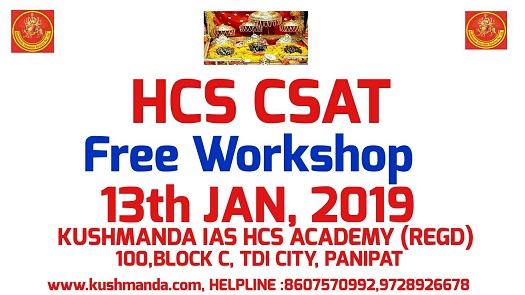
]]>You want to reserve your seat for Free HCS CSAT Workshop ? Please don’t hesitate to Call/sms/What app us.
Our HELPLINE: 8607570992,9728926678
The post HCS CSAT Free Workshop appeared first on Kushmanda Education.
]]>