The post Haryana Naib Tehsildar Exam 2018 Crash Course appeared first on Kushmanda Education.
]]>Batch Start :1 Sept , 2:00 PM-6:00 PM
What you will get :
- Interactive Classes (Most Expected & Probable Questions)
- Daily Classes lectures Notes will be sent in PDF Format(Hindi / English)
- Complete Study Material (Printed Form)
- Test Series
KUSHMANDA IAS HCS ACADEMY
(KUSHMANDA EDUCATION SERVICES PVT LTD)
100, BLOCK-C,TDI CITY,
PANIPAT
HARYANA
Helpline: 08607570992, 09728926678
EMAIL: kushmandaeducation@gmail.com
The post Haryana Naib Tehsildar Exam 2018 Crash Course appeared first on Kushmanda Education.
]]>The post Haryana Naib Tehsildar Exam Pendrive Course/Notes/Online Live Course appeared first on Kushmanda Education.
]]>Haryana Naib Tehsildar Exam Pendrive Course
“We have an edge over others in Distance Learning Programs through our unique teaching and learning techniques.”
Haryana Naib Tehsildar Exam Pendrive Course : Make your education digital
Features:
- India’s Best Faculties (Abhi Sir,writer of more than 20 books for competitive exams)
- Complete Syllabus
- No Internet Connection Required.
- Learn with the Comfort of Home.
- Unlimited Times Video Play.
You will Get:
- Recorded Video Lectures
- Complete Study Material
- Test Series
- Expert support: Through email: kushmandaeducation@gmail.com
HELPLINE:8607570992,9728926678
Fee: 12000/-
Haryana Naib Tehsildar (Study Material Course,Kushmanda Distance Learning Program 2018)
PAPER
WHAT YOU WILL GET:
- COMPLETE STUDY MATERIAL
- TEST PAERS (MOST EXPECTED QUESTIONS)
- Expert Support ( through email kushmandaeducation@gmail.com)
- English/Hindi Medium
Fee:Rs 6000/-
Fee has to be paid-by Cash on Delivery or NET BANKING(IMPS/NEFT) or by DD/Cheque for the full amount favoring KUSHMANDA EDUCATION SERVICES PVT LTD payable at PANIPAT . “Trust, quality and reliability , the bywords for KUSHMANDA EDUCATION SERVICES PVT LTD, will remain our guiding force for both Preliminary as well as Main Exam.”
How to send request: Only one single call on our helpline number 08607570992,09728926678
KUSHMANDA EDUCATION SERVICES PVT LTD(REGD), 100 BLOCK C, TDI CITY, PANIPAT, HARYANA
Haryana Naib Tehsildar Online Live Course
What you will get :
- Online Live Interactive Classes (Most Expected & Probable Questions)
- Daily Classes lectures Notes will be sent in PDF Format(Hindi / English)
- Complete Study Material (Printed Form)
- Daily Classes Video Recordings*** will Be sent through Email. (***You can use these video recordings for your own personal use only, and you are not allowed to sell, lease or trade the copy to another person/website or facebook/youtube etc. )
- Weekly Test Every Sunday
FEE:Rs 27000/-
The advantages of taking online courses :
1.Convenient (available 24/7): Both the classroom and instructor are available 24/7 with online education. (Morning/Evening/Night/Weekend Batches)
2. Flexible:You can study anywhere-anytime.You can study with wherever you want to, from the comfort of your home or in the library or the bus. You get to choose the place.
3.Online education at your doorstep:The involvement in the course is high.Online learning helps the parents to look over and know what their children are studying.
4. Individual attention:Online courses have a significant advantage when it comes to serving direct pipeline between the student and the online tutor. Ask questions or clearing doubts.
6. Efficient and active learning:How many of us remember what we read in Grade 6th or any course we have learnt? The reality is, we are not capable of retaining that is learnt. But with online training, we tend to remember what is taught. Daily classes recordings will be sent through email .
7.Less expensive: Online courses are less expensive when compared to classroom coaching.One can save a lot on travelling cost and time, boarding/lodging cost etc .
“We have an edge over others in Distance Learning Programs through our unique teaching and learning techniques.”
KUSHMANDA EDUCATION SERVICES PVT LTD
100, BLOCK-C,TDI CITY,
PANIPAT
HARYANA
HELPLINE:8607570992,9728926678
The post Haryana Naib Tehsildar Exam Pendrive Course/Notes/Online Live Course appeared first on Kushmanda Education.
]]>The post Haryana Naib Tehsildar Exam 2018 appeared first on Kushmanda Education.
]]>Imp Facts:
Haryana Naib Tehsildar Exam 2018
Khewat Number
The Khewat number normally referred as ’KHATA NUMBER’ by revenue officials is the account number given to owner(s) which form a set of co-sharers who own the land in same or different proportions. It therefore, can be understood as the account number given to various owners in the Khewat. The Khewat number in the Jamabandi runs sequentially starting from 1 to N.
The Khewat Number may get changed in the next Jamabandi due to rearrangements i.e. same owners who were owners in some Khewat earlier may get another Khewat number in next Jamabandi. To clarify the things further, let us assume that there are 10 Khewats in a village and owners A, B & C were earlier in ownership of the Khewat 5 and did some transactions to a person say X who may be an owner in this village already or may appear in the Shajra and Jamabandi of the village due to this transaction for the first time. Now due to mutation(s), it may be the case that owners in Khewat number 5 sold complete land to X. If complete Khewat is sold and owner ’X’ already exists in the village, then all the land will shift to Khewat that belongs to X. In case owner ’X’ is a new owner and was not there in the Jamabandi earlier, then during mutation entry Khewat number 5 will cease to exist and instead Khewat number 5/1 will be given to ’X’. During final rearrangement / sequencing of Khewat number, then it may be the case that depending upon the caste/sub-caste of the Owner ’X’ now Khewat number 5/1 (Khewat created from 5) may get another number.
The arrangement, which has been shown above is a simple one for the purpose of understanding but in real situations it may be more complicated one depending upon the nature and type of mutations taking place in the village.
You may say if above is the case then what is the way to know the Khewat of owners in the previous Jamabandi. This can be known with the help of Khewat number written with red ink (in computerized print it is shown as underlined) beneath the current Khewat number. In case you see Khewat number 6 (in blank ink) and beneath that Khewat a number say 5 is written in red-ink, then you can simply assume that present owners of Khewat number 6 in the current Jamabandi were owners in Khewat number 5 in the previous Jamabandi.
Sometimes, a denominator is attached to a Khewat number also. This happens because of the fact that during the writing of Jamabandi and arrangement of Khewat numbers, a Khewat is left inadvertently and has to be inserted in between. For example though there were 10 Khewats and Patwari tried wrote the details for 10 Khewat in sequence one after another but forgot to mention a Khewat in between. Such Khewat if is to be inserted after Khewat 6 will be given number 6/1 or if is to be inserted after 8 will be given number 8/1. Though this practice of writing Khewat number is wrong but there is no immediate solution available. A facility has been given to enter such Khewats also by giving additional field i.e. bata (denominator) for such Khewat number. However, after the mutations, once a new Jamabandi is prepared, such denominators will not be allowed.
Above is true in case of khatoni number also. But for denominator of Khasra, there is specific meaning and it has been explained in the section 2.4 ’Khasra Number’.
Khatoni Number
As Khewat number refers to a set of owners, khatoni number refers to a set of cultivators in the same sense. This khatoni number is given to the cultivators in the Khewat and runs sequentially in the village starting from 1 to N. Each Khewat will have at least one khatoni or more khatonies but will appear in a sequence within the Khewat and in the village.
The Khatoni number if in one sense shows the cultivators then in another sense will show who are the persons who have the possession of the Khatoni consisting of various Khasras in the Khewat. In still another sense it also shows who are the persons who are owners of various khasras in the khatoni. In the same way as in case of Khewat where owner may sell, gift or mortgage, same type of transaction also takes place in the Khatoni also. Before the things start confusing you, the example shown below would help you to understand this issue.
Say, A, B & C are owners in Khewat number 5 and this Khewat has three Khatonies number 5, 6 and 7. In Khatoni number 5, it is written ’Kast Va Kabja Swayam’ and has got three khasras. Then this means that these three khasra are collectively possessed and cultivated by all the three owners mentioned in Col.4 i.e. Owners Details of Jamabandi. In the next khatoni i.e. Khatoni number 6 which say has one khasra and it is written ’A, B, C Hissadar Baya X Mustari Kast Va Kabja Swayam Mustari’. This description means that the Khasra in the khatoni number 6 has been sold by all the three owners collectively i.e. A, B & C to X who is the owner in ’Khana Kast’. This is because of the fact that owners A, B and C have sold a particular khasra number to X and X will be shown in khatoni number 6 as buyer and possession is also with X i.e. the purchaser. The purchaser will not get any Khewat number for the reason that khasra sold was earlier under the possession with all the three owners. Purchaser X will get another Khewat only when this Khewat number gets divided and shares are worked out based upon the area owned by each owner.
Beneath the khatoni number, another number is written (underlined in computerised print) in red ink in the manually written Jamabandi) which shows the Khatoni number of current Khatoni in the previous Jamabandi. In the manually written Jamabandi this number is not shown. But once the mutations take place through this software and Khatonies are rearranged, then under each current Khatoni number, old Khatoni number would be shown as underlined.
As explained under section 2.2, that in the manually written Jamabandi, sometimes a bata (denominator) is added to show the Khewat inserted in between. It is also true in case of Khatoni.
Khasra Number
The Khasra number is nothing but a plot number given to a specific piece of land in the village. Same way as one or more Khatonies form a Khewat, similarly one or more Khasra form a khatoni. The Khasra numbers in a khatoni may or may not be mentioned sequentially and once a khasra number has appeared in a khatoni, it can not figure in another Khatoni except in the case if the Khasra is ’Min’. But if it is min then it can not repeat in the same Khatoni.
The Khasra numbers in a village are created once settlement of village starts. The settlement officials take village as a whole and on its map start from North East and give number to each and every plot in each direction and reach to North East direction again after giving number to each plot in all the directions.
Khasra number may get divided due to sale, gift etc. during the mutation and is given a new number with denominator. For example, because of mutation, Khasra number 100 is divided into two parts then during mutation two divisions of this khasra i.e. 100/1 and 100/2 will be created and transaction takes place. Once all the mutations have taken place the rearrangement of Khasra i.e. numbering is done by Patwari. How this renumbering/rearrangement is done is explained below:
Say in the village only 499 Khasras were there in the previous Jamabandi and two new khasra divisions i.e. 100/1 and 100/2 were created due to mutation. During reorganisation, Khasra number 100/1 will get number 500/100 and 100/2 will get Khasra number 501/100 and khasra number 100 will cease to exists i.e. the last Khasra number is incremented by one (that is 499 now become 500 and 501) and in the denominator Khasra number out of which the Khasra is formed is attached. This will be the case for all the Khasra divisions. New Khasra number generation takes into account the principal of ’First-In First-Out (FIFO)’ that is Khasra which got divided due to mutation number 5 will have precedence in getting new number over the khasra number which has been divided due to mutation number 10. To make the things further clear, let us say that khasra 100 was divided due to mutation number 5 and Khasra number 45 was divided into two parts (i.e. 45/1 and 45/2) due to mutation number 10. Then once the mutations are over and rearrangement of Khasra is undertaken, then new Khasra numbers are generated based upon the principal of ’FIFO’. Suppose last khasra in previous Jamabandi was 499 then new Khasra number will be 500/100, 501/100 (for khasra number 100) and 502/45 and 503/45 (For Khasra Number 45). So the example clarifies though the khasra number 45 is a number lesser than Khasra number 100 yet Khasra numbers generated out of 45 due to mutation number 10 will get next i.e. higher numbers.
Group Number
During the execution of this software, you will often encounter the term ’Group Number’ not visible in the Jamabandi anywhere but software making abundant use of this term. The group number has been given to each owner who himself or along with other owners owns a specific proportion of land in the Khewat or who have same parentage. Group number will also refer to the owners in the different proportions even if their parentage is same. During the writing of Khatoni description also, sometimes group numbers are generated to show the groups of cultivators.
Min & Salam
In the course of the implementation of Land Records Computerisation software you will often see the term Min/Saalam (feu / lkye) invariably. The ’Min’ means partially and ’Saalam’ means completely. If min is mentioned against an old Khewat/Khatoni/Khasra number then you can assume that the Khewat / khatoni / khasra under consideration is carved / formed out of the old Khewat / Khatoni / Khasra partially or transaction is taking place partially. ’Salam’ word refers to the fact that new Khewat / Khatoni / Khasra is formed out of the old Khewat / Khatoni / Khasra when same was transacted completely. In case the Khewat / Khatoni / Khasra is formed due to min transaction, then you will see ’Min’ besides the Khewat / Khatoni / Khasra. In case nothing is mentioned then you can very well assume that the Khewat / khatoni / khasra is ’Salam’, by default.
Mortgagee
In case an owner takes loan from some individual or an institution with the security of his land then the deed is known as Mortgage deed and persons / institutions from which loan is taken are known as mortgagee. If mortgage takes place from one persons to another, then the mostly mortgage is with possession that is the mortgagee has the possession of the piece of land mortgaged and in revenue terminology it is known as ‘RAHIN’. If the mortgage takes place and loan is taken from some Government Institution, then the mortgage is without possession and it is known as ‘AD-RAHIN’
Awaal / Doaym / Soyam
Suppose A took loan from B and after mortgaging the land to B then B is known as Mortgagee ’Awwal’ if B further takes loan from ’C’ after keeping the land mortgaged as security, which he had taken from A. Then C will be known as Mortgagee ’Doyam’. If C further mortgage the land taken from B to D then D will be referred as Mortgagee ’Soyam’.
Type of Holding
During the course of entering the khatoni details, there is a field known as ’Type Holding’. The type of holding will be ’Individual’ if the possession and ownership rests with the same family. In case the holding is owned by more than one family then the holding type will be ’Joint’. If both are not true for a holding then the holding type will be ‘Institutional’. This information is very important to understand and should be entered carefully as in Agriculture Census the information is analysed based upon this parameter.
Patti
In the British regime a village was divided into number of patties/sections based upon the caste of the persons residing in that village. For example, Rajput used to dwell in a separate location, Brahimn in other and ’Shudras’ still in another location. These locations were known as ’pattis’. But after the independence, this classification was changed and at present refers to various cluster / hemlets in the village in which villagers reside in groups irrespective of their caste.
Chak Tashkhish
This term refers to land classification in a broader sense. If it is ’Parvati’ then it means that the village falls in mountainous area. In case if it is known, as ’Changar’ then it means that in the area in which village falls, irrigation is totally rain-fed. There are different land classifications based upon this land classification.
Conversion Factor
Conversion factor (ranges from 0.000 to 1.000) is specified to convert the local area unit prevalent in the village to the Metric System i.e. mentioned in terms of Hectares-Ares-Centares. When the local unit is multiplied with this conversion factor then the area in Metric system can be obtained. The reports sent to Government of India are firstly converted to the Metric system if local unit is different from the Metric system.
If the local unit is Kanal-Marla then a kanal has 20 Marlas. If local unit is ’Bigha-Biswa-Biswansi’ then 20 Biswansi make up a Biswa and 20 Biswa make a Bigha. If local area unit is ’Meters–Decimetres’ (normally in the urban areas where khasra/plots are very small) then 100 decimetre make up a meter. In case, the local unit is ’Hectare-Ares-Centeres’, then 100 centare (equal to a meter) form an Are and 100 are form a Hectare. Therefore a hectare refers to 10000 metres of land.
Revenue Unit
On behalf of Govt., the Nambardar of a village collects land revenue and deposits the revenue in the Treasury. This service rendered by the Nambardar is a paid one.
The rate of swai changes from time to time and at present it is 65% of total demand that is if demand is Rs. 1/- then swai will be 0.65 paisa and total revenue to be collected from the owner(s) will be Rs.1.65/-. Of this 65%, 30 is local rate and 35% is Nambardari that is the amount given to the Nambardar for this service.
Percentage Collection of Land Revenue
The land revenue collection is normally done twice a year by the Govt. through Nambardar in such a way that land revenue collection is done half in Kharif and half in Rabi season. But sometimes it is done in different percentage proportion say 60% in Kharif and 40% in Rabi or as the villagers decide at the time of Permanent Settlement.
Professional Area of Village
The professional area of village is measured by the Survey of India organisation. And in all the Agriculture Census reports this area figures are mentioned. It has been observed that normally Patwari is not aware of professional area. If that is the case, then actual area mentioned in the village may be entered against this field where ever referred to.
Alamat
This term will appear during the entry of Shajra Nasb. This normally connotes a person’s characteristic. If an owner has alamat as ’Bandobasti Kabij’ / ^^cUnkscLrh dkfct^^ then that means that the owner was also owner at the time of settlement. In case alamat is ’Baap Dada Jivit Hai’ / ^^cki nknk thfor gS^^ then it means that the owner’s father/grandfather are alive. These alamat details are to be entered correctly as the processing & printing of Shajra Nasb depends upon this field information. For example, even if an owner’s father and grandfather are not alive but entered as alive then the box of the father and grand father will be depicted left to the owner’s box whereas if this alamat is not there and not filled then owner’s box will be exactly below the box of his father and father’s box will be beneath the box of owner’s grand father.
Total Shares
In Column 4 of Jamabandi, in the very beginning, total shares are mentioned. These shares are in proportion to the total area of the Khewat. For example if there 100 shares mentioned and total area of the Khewat is 1000 meters then that means each share is worth 10 meters. (1000mts. / 100shares)
Further each group shares are mentioned which are in proportion to the total area of the Khewat. For example there are three groups in the Khewat with respective shares as 10, 30 and 50. If in first group there are 2 owners then each owner will have 10 shares each and owns 100 meters of land. If in next group also there are two owners then each will own 15 share i.e. 150 meters of land each. In the third group there are 5 owners then each owns 10 shares which equivalent to 100 meters of land to each owner. So the total land comes out to be 1000mts.
Lagan
In case the land is cultivated by other than the owner of the land, then the person cultivating the land is liable to pay something either is cash or kind to the owner or agreed based upon the mutual agreement between the two. The agreement between two parties is known as ’Lagan’. Sometimes if there is sale deed in the Khatoni, then the revenue will be mentioned in this column in that case.
Mazrua (Krisht)/Giar Mazrua (Akrisht)
In case the land of khasra is such that it is possible to cultivate it either through man-made irrigation sources or through rainwater then land type is known as ’Mazrua’ otherwise it is known as ’Gair-Mazrua’.
Under the ’Gair-Mazrua’ land classification one term is usually referred to, as ’Gair-Mumkin’ which specifies that anything constructed on it, is impossible to shift. For example, if a house is constructed on a piece of land, then the classification of that Khasra will be ’Gair-Mumkin Makan’ as it is impossible to shift the same house somewhere else.
Wazib_Ul_Arj & Peshani
The customary rights of the village are shown in a report known as ’Wazib_Ul_Arj’. The attestation of these customary rights by the revenue officer in front of village and signature of villagers to whom the customary rights information is read is known Peshani.
Bartan
The TD rights or forestry rights of the villagers in revenue terminology are known as ’Bartan’.
Common Terminology
|
Term |
Description of Term |
| Abadi Deh | Site of village where predominantly people live. |
| Badastur | Unaltered / Same As |
| Banjar | Uncultivated land |
| Banjar Jadid | New fellow (land not cultivated for continuous four harvests though it was cultivated earlier. |
| Banjar Kadim | Old fallow (If continued to be uncultivated for next four harvests) |
| Barani | Dependent on rainfall |
| Bigha | A measure of area (It is different in different areas based upon local Karam unit) |
| Biswa | One twentieth of a bigha |
| Biswansi | One twentieth of a biswa |
| Chahi | Irrigated from well |
| Chahi Nahri | Irrigated partly from a well and partly from canal. |
| Chkota | Lump sum grain rent or rent consisting of a foxed amount of grain in the Rabi and Kharif. |
| Gair-Mumkin | A type of land on which existing arrangement are difficult to move. |
| Girdawar | Kanungo or Supervisor of Patwaris |
| Girdawari | Harvest Inspection |
| Karam | Unit of Length and varies from tehsil to tehsil and district to district. |
| Kharaba | Portion of crop that has failed to come due some calamity |
| Kharif | Autumn harvest |
| Khasra | List of fields, field register |
| Khasra Girdawari | Harvest Inspection Register |
| Khata | Holding of tenant |
| Khatauni | Holding slips prepared at re-measurement |
| Khewat | A list of Owner’s holding |
| Khud Kashat | Cultivated by the owner himself |
| Killabandi | Rectangular measurement |
| Lamaberdar | Village Headman |
| Latha Girdawari | Cloth copy of the Patwari’s Map |
| Marla | Measuring of Area |
| Mauza | Village |
| Min | Portion / Part |
| Misal Haqiyat | Record-of-Right prepared at the time of settlement. |
| Musavi | Mapping Sheet |
| Nahri | Irrigated from canal |
| Parat Patwar | Patwari copy of the new settlement record |
| Parat Sarkar | Government Copy of the new settlement record |
| Rabi | Spring Harvest |
| Sabika | Former |
| Taccavi | Loan granted by a Government to landowner for agriculture purposes. |
| Waris | Successor |
| Wasil Baqi Nawis | Revenue Accountant in the Tehsil |
| Zamindar | Landowner |
| Varsal | This type of Mutation is caused by either death or will of a person. In case of death of a person in the family, Patwari records the details regarding name of the person who has died, date of death and entry number of Chawkidar Register in his Roznamcha Waqaiti (Diary of daily events). Land can also be transferred to the successors i.e. sons, daughters, relative or any other person even if the owner is alive by way of his will. |
| Bai | Whenever a person sells his land either completely or partially, to another person, this type of mutation is know as Bai or Sale. The information recorded in this case is Sale Deed No., date of Registry and amount of Registration etc. |
| Tabdeel Malkiat: | This type of mutation is carried out after the settlement of dispute by some court. This is also know as degree by court (Ba Hakumat Adalat). The information recorded in this case includes Case Number, Date of starting of Case, Date of Judgment, Name of the Court, Name of the Judge, names of the persons who filed the Case, Names of the persons on whom Case is filed & Judgment Details etc. |
| Rahin (Mortgage Deed) | Whenever a land is mortgaged, completely or partially, to another person or party, mutation is of Rahin type. The deal can be either verbal or through Registry. In this case information like Date of Mortgage, Amount and Registry No.(or Roznamcha No. in case the deal is verbal). The land can be mortgaged with or without possession. |
| Fak-Ul-Rahin (Redemption deed of Mortgage) | This type of mutation is reverse process of Rahin. Whenever a person who has mortgaged his land want to get it back after paying dues to the mortgagee, the type of mutation is called Fak-ul-Rahin. It can be of two sub types. Verbal (through Roznamcha) or through
Registry. In case of verbal type, the details include type of Mortgage Serial No. of Roznamcha Waqaiti amount of Mortgage returned etc. In case of Registry, Deed No. is also recorded in addition to the above information. |
| Tabadala | Tabadla or mutation of exchange is the mutation, when two owners decide to exchange their lands. It can Again be either verbal (through Roznamcha Waqaiti) or through Registry.The details recorded are similar as those in the previous case i.e. either through Roznamcha Waqaiti entry or through Registry. |
| Hibba (Gift): | Whenever a part of complete land is gifted to some person, the mutation is called Hibba or Gift. The details of the person to whom land has been gifted are recorded. |
| Pattanama | Whenever a piece of land is given on lease for a long period, the mutation is known as Pattanama. |
| Takseem | Whenever there is a division of land in a joint holding, the mutation is known as Takseem or Mutation of Partition. The partition can be verbal among the landowners or when court directs the partition. |
Documents
SHAJRA NASB
Prepared in every estate at the time of settlement, it forms a part of record of rights. Shajra Nasb is a pedigree table showing succession to ownership rights occurring from time to time in an estate. It is revised after every five years along with Jamabandi and in the interval, changes occurring from time to time are reflected in the Patwari’s copy through suitable references.
The Shajra Nasb also serves as an index for locating an owner’s accounts (Khata Numbers) in the Jamabandi. In the new Jamabandi owner’s accounts are arranged as per arrangement in the Shajra Nasb. The name of owner in the Shajra Nasb is arranged according to caste and sub-caste.
JAMABANDI REGISTER
It is prepared quinquenially in duplicate for every estate on the basis of entries existing and changes recorded on the Mutation Register, Khasra Girdawari Register and Fard Badr over a period of 5 years. It is the document to which a presumption of truth is attached. The form of the Jamabandi has 12 columns and gives Khewat / Khatoni number-wise information of total holding of each owner of land in a particular revenue estate. It also indicates cultivation, rent and revenue and other cesses payable on land and constitutes an up to date record of various rights in land. The new Jamabandi is prepared by the Patwari and is attested by the Revenue Office in a public meeting of local villages. Two copies of the revised Jamabandi are prepared, one copy is filed to the District Record Room and other copy remains with the Patwari. All changes in title/interests of the revenue estate coming into the notice of Revenue Authorities are duly reflected in the Jamabandi according to set procedures.
MUTATION REGISTER
All changes in title or interest are incorporated into the Jamabandi through attestation of mutation. The Patwari enters the mutations on the basis of a document/verbal information presented by the concerned parties for the change in title/interest on land. This information is first entered into the Patwari’s Diary (Roznamcha Wakyati) giving serial no. And date and then into the mutation register referencing the Roznamcha no. However, the final changes in the Jamabandi are made only after the Revenue officer has attested the mutation. The mutation form has 15 columns and every entry is given a Serial Number, which is called Mutation Number. This Mutation Number runs continuously from one settlement to another for each estate. The Mutation register is maintained by the Patwari and all entries are made in duplicate. The Patwari’s copy (PARAT PATWAR) contains the brief substance of the Revenue Officer’s order, while the other copy (PARAT SARKAR) contains the detailed order and is kept in the Tehsil in separate estate-wise bundles. Whenever a mutation is entered, the Patwari makes a note in the remark column of the Jamabandi in pencil giving the Mutation No. and type of mutation. When the mutation is attested, he makes the entry in Red ink, giving Mutation No., type and date of attestation.
When the new Jamabandi is written, all the mutations accepted are attached to the new Jamabandi for cross-reference and an index sheet linking the mutations to the Khatas is placed in the Jamabandi.
KHASRA GIRDAWARI
It is a register of harvest inspections unlike the Jamabandi, which is Khewat-wise, the Girdawari, is Khasra-wise. The Patwari conducts a field to field harvest inspections every six months in the month of October and April. He records the plot-wise details regarding crop grown, land description and status of the cultivator This register is considered important as it acts as master file for the preparation of many returns and reports. This document is retained in the custody of Patwari for the period of 12 years after which it is retrieved from him and destroyed. No presumption of truth is attached to this record though entries in it are often used as evidence in courts. Changes in the tenancy however are made through mutations in view of Section 10-A on the Tenancy Act.
FIELD MAP
A field map for every revenue village is prepared at the time of the Settlement. The original map is called ’MUSAVI’. Its updated version is called ’SHAJRA KISTWAR’ and these are kept in safe custody in the Record Room. A wax copy called ‘MOMI’ is available in the Tehsil.
All changes in field boundaries occurring due to partition, sale etc. attested in Mutation are entered from the Parat Sarkar Mutation onto the Momi. A copy on cloth called ’LATHA’ is kept and updated by the Patwari.
VILLAGE NOTE BOOK
Popularly known as “LAL KITAB” these are prepared at the time of settlement. The kitab has valuable information regarding crops grown in the estate, soil classification, area under different crops, land use, transfers in land, wells and other means of irrigation in the village and abstract of the livestock and cattle census in the village. The data is updated regularly through harvest inspections and revisions of other records, which are the main source of the data to this kitab. These Lal Kitabs are prepared at village, tehsil and district level and maintained in the Patwari Office, Kanungo and Sadar Kanungo respectively.
WAZIB-UL-ARJ
In this customary rights of the villagers are maintained. This information is attached at the end of the Misal Hakiyat(Permanent Settlement). In the subsequent Jamabandies this information is not attached.
NAKSHA BARTAN
The forestry right popularly known as TD rights details is maintained in this document. This too is the part of Misal Hakiyat(Permanent Settlement). In subsequent Jamabandies, this information is not attached.
Haryana Naib Tehsildar Exam 2017 Online Classes On Phone
| MORNING BATCH |
- STARTS ON JAN – 30th jan 2018 TIMINGS: 06:00am – 08:00am (Monday – Friday)
“We have an edge over others in Distance Learning Programs through our unique teaching and learning techniques.”
What you will get
- Online Lectures
- Complete Study Material
- 30 Practice Test Paper (Most Realistic Practice )
- Expert Support ( through email kushmandaeducation@gmail.com)
- English/Hindi Medium
Fee-27,000/- Rs
Our helpline number 08607570992,09728926678
KUSHMANDA EDUCATION SERVICES PVT LTD
C-100, TDI CITY,
PANIPAT
HARYANA
Helpline: 08607570992, 09728926678
We would take around 5 days to deliver the material (or 1st installment, if applicable) in India from the day we receive your DD/cheque.
FOR ANY POSTAL MATERIAL RELATED QUERY OR TO KNOW THE STATUS OF MATERIAL ORDERED, KINDLY SEND EMAIL USkushmandaeducation@gmail.com
Or call us 08607570992,09728926678
(FOR FREE ONE SAMPLE MOCK TEST & MODEL ANSWERS CALL US OR SMS US Helpline: 08607570992, 09728926678, email kushmandaeducation@gmail.com )

The post Haryana Naib Tehsildar Exam 2018 appeared first on Kushmanda Education.
]]>The post Haryana Naib Tehsildar Exam 2017 Mock Test 1 Free Download appeared first on Kushmanda Education.
]]>KUSHMANDA DISTANCE LEARNING PROGRAMME for Haryana Naib Tehsildar Exam 2017
Kushmanda Distance Learning Programme for Naib Tehsildar Exam 2016
What you will get
- Complete Study Material(Updated 2016)
- Practice Test Paper (Most Realistic Practice/Updated 2016 )
- Expert Support ( through email kushmandaeducation@gmail.com)
- English/Hindi Medium
Fee-6000/- Rs
(FOR FREE ONE SAMPLE MOCK TEST & MODEL ANSWERS CALL US OR SMS US Helpline: 08607570992, 09728926678, email kushmandaeducation@gmail.com )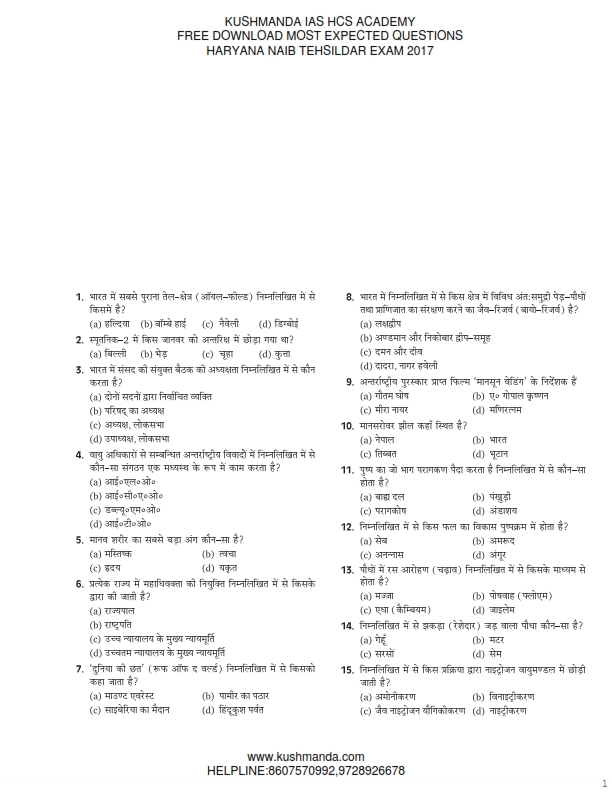
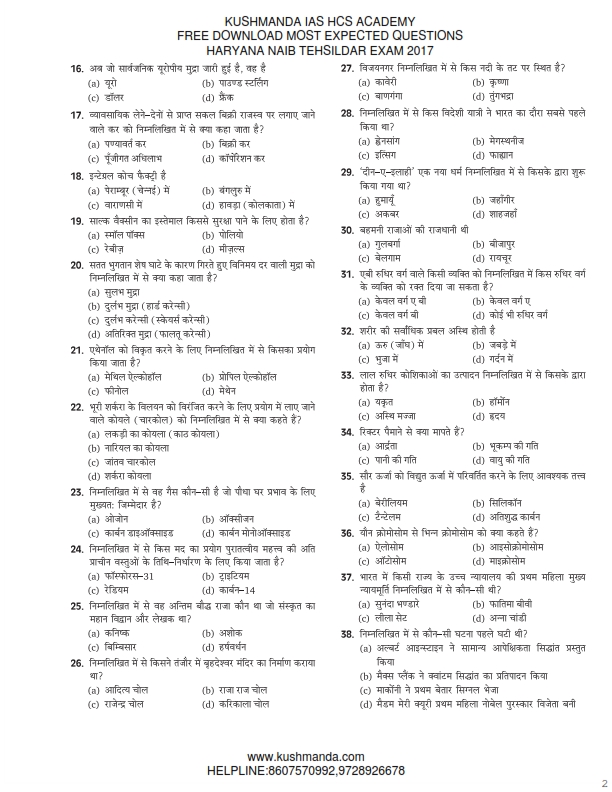
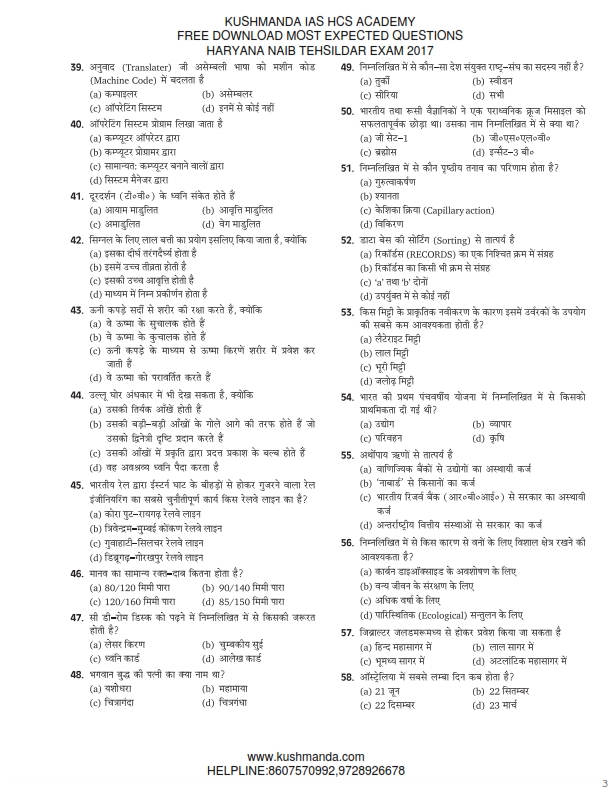
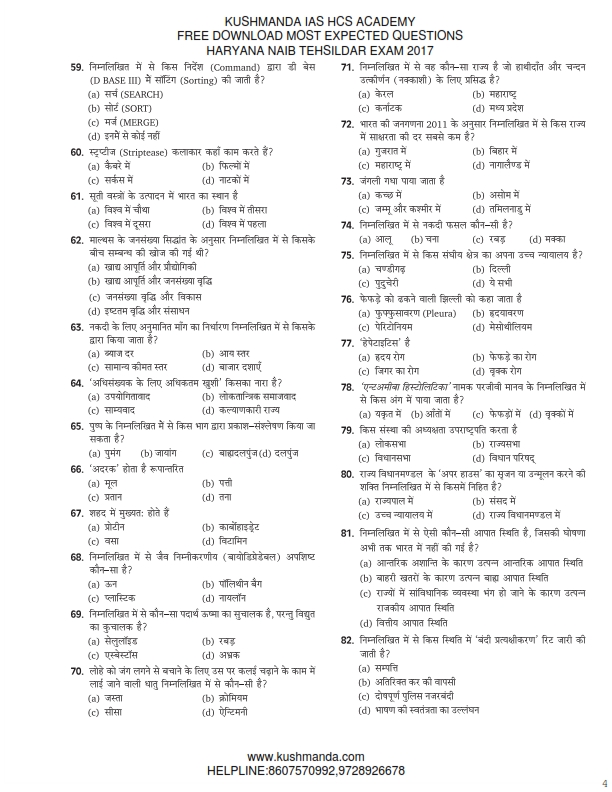
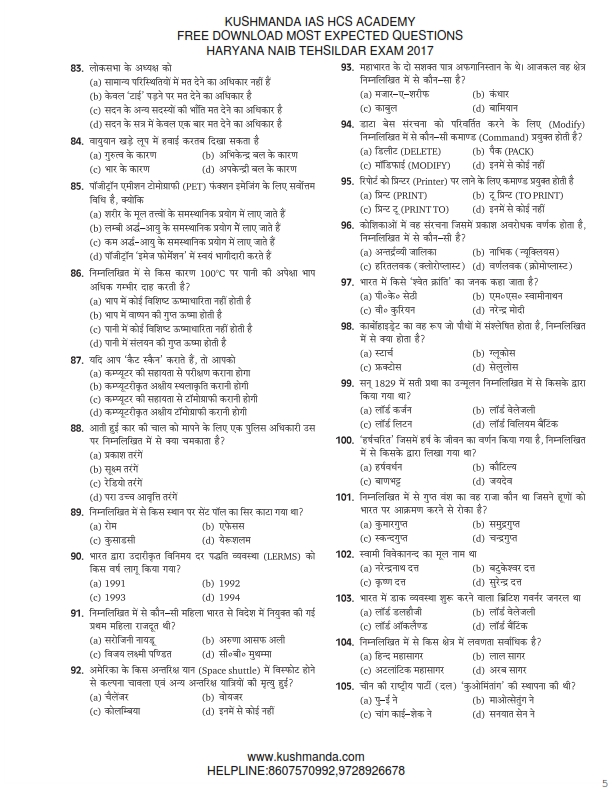
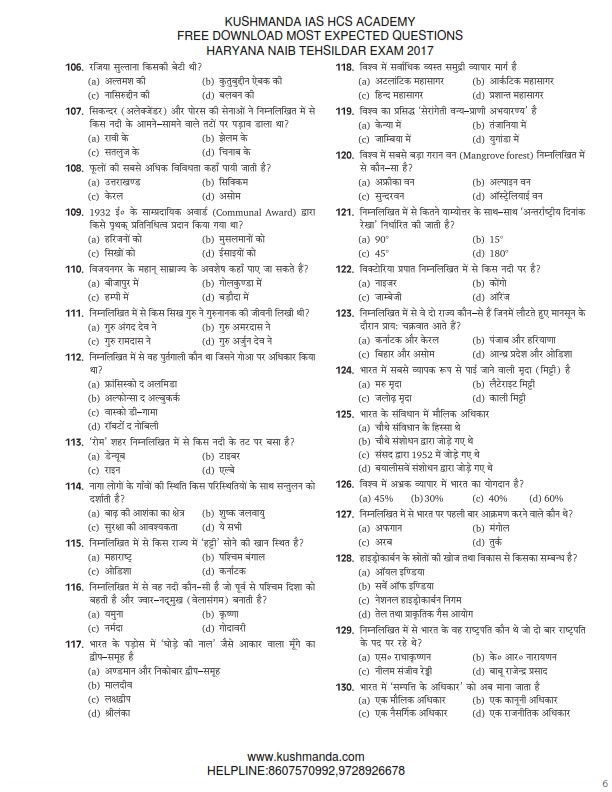
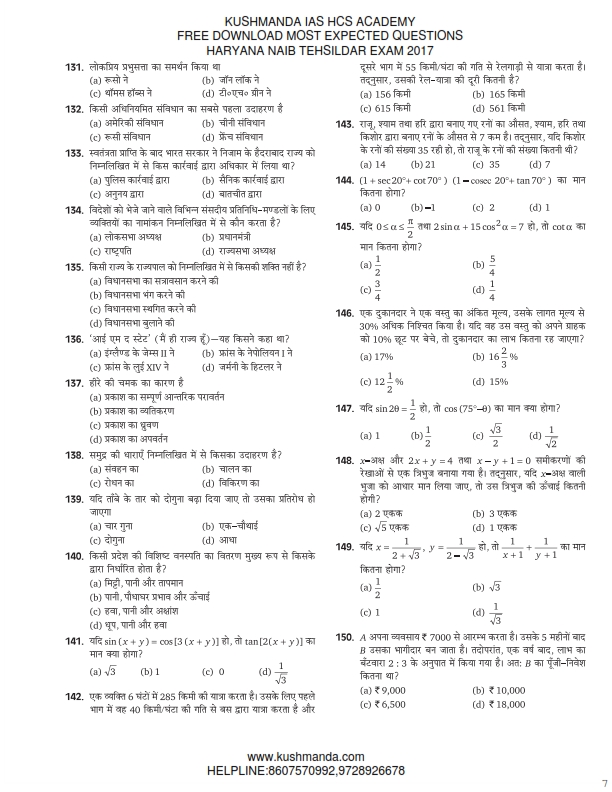
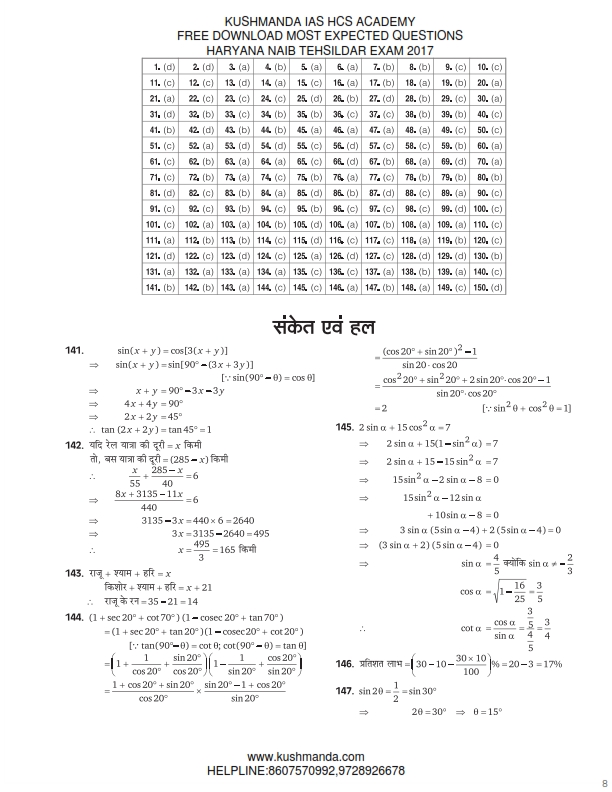
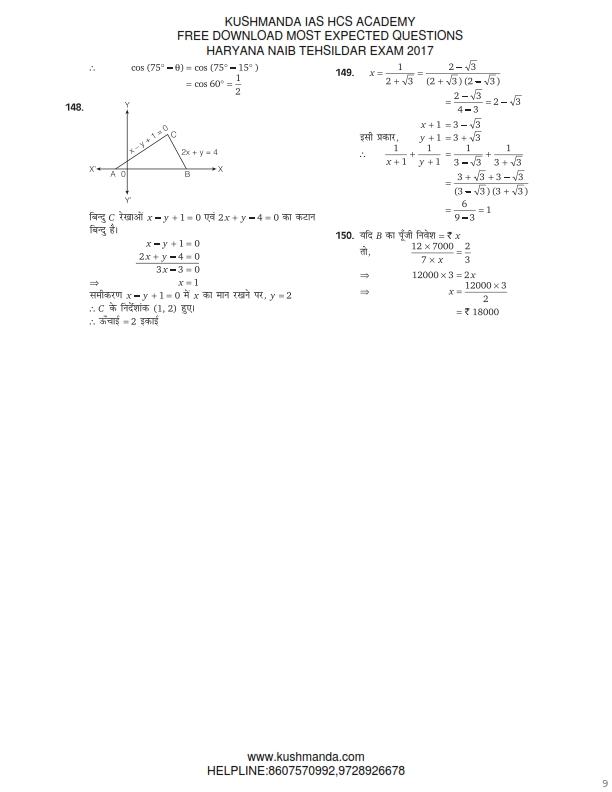

Fee has to be paid-by Cash on Delivery or by DD/Cheque for the full amount favoring KUSHMANDA EDUCATION SERVICES PVT LTD payable at PANIPAT .Trust, quality and reliability the bywords for KUSHMANDA EDUCATION SERVICES PVT LTD will remain our guiding force for both Preliminary as well as Main Exam.
How to send request:
Only one single call on our helpline number 08607570992,09728926678
or
Students can download the respective application form.
After filling the form, attach the DD/Cheque and send it to us at the address mentioned below:
KUSHMANDA EDUCATION SERVICES PVT LTD
C-100, TDI CITY,
PANIPAT
HARYANA
Helpline: 08607570992, 09728926678
OFFICE PHONE NO-08570940555,08570940666, 01806539177
We would take around 5 days to deliver the material (or 1st installment, if applicable) in India from the day we receive your DD/cheque.
FOR ANY POSTAL MATERIAL RELATED QUERY OR TO KNOW THE STATUS OF MATERIAL ORDERED, KINDLY SEND EMAIL USkushmandaeducation@gmail.com
Or call us 08607570992,09728926678
(FOR FREE ONE SAMPLE MOCK TEST & MODEL ANSWERS CALL US OR SMS US Helpline: 08607570992, 09728926678, email kushmandaeducation@gmail.com )
The post Haryana Naib Tehsildar Exam 2017 Mock Test 1 Free Download appeared first on Kushmanda Education.
]]>